
The Right Choice of Cover Crop

Choosing the Right Cover Crops: Mixtures for Autumn
Cover Crop Mixtures: Choosing the Right Blend After Harvest
Harvest is in and the stubble fields lie open – and for you, as a farmer, one of autumn's key decisions now comes into focus: which cover crop suits your location, your crop rotation and your objectives?
At Freudenberger, our advisory practice shows year after year just how different these requirements can be. Where soil structure and rooting are the priority, deep-rooting components such as fodder radish or tillage radish are recommended. Where nitrogen fixation is the main goal, legume components – such as winter vetch or crimson clover – are indispensable. For those wishing to use the cover crop additionally as grazing or cut forage, balanced mixtures with a high feed value are advisable, for example combinations of clover species, phacelia and cereal components.
Why Cover Crops Are More Than Just a “Box to Tick”
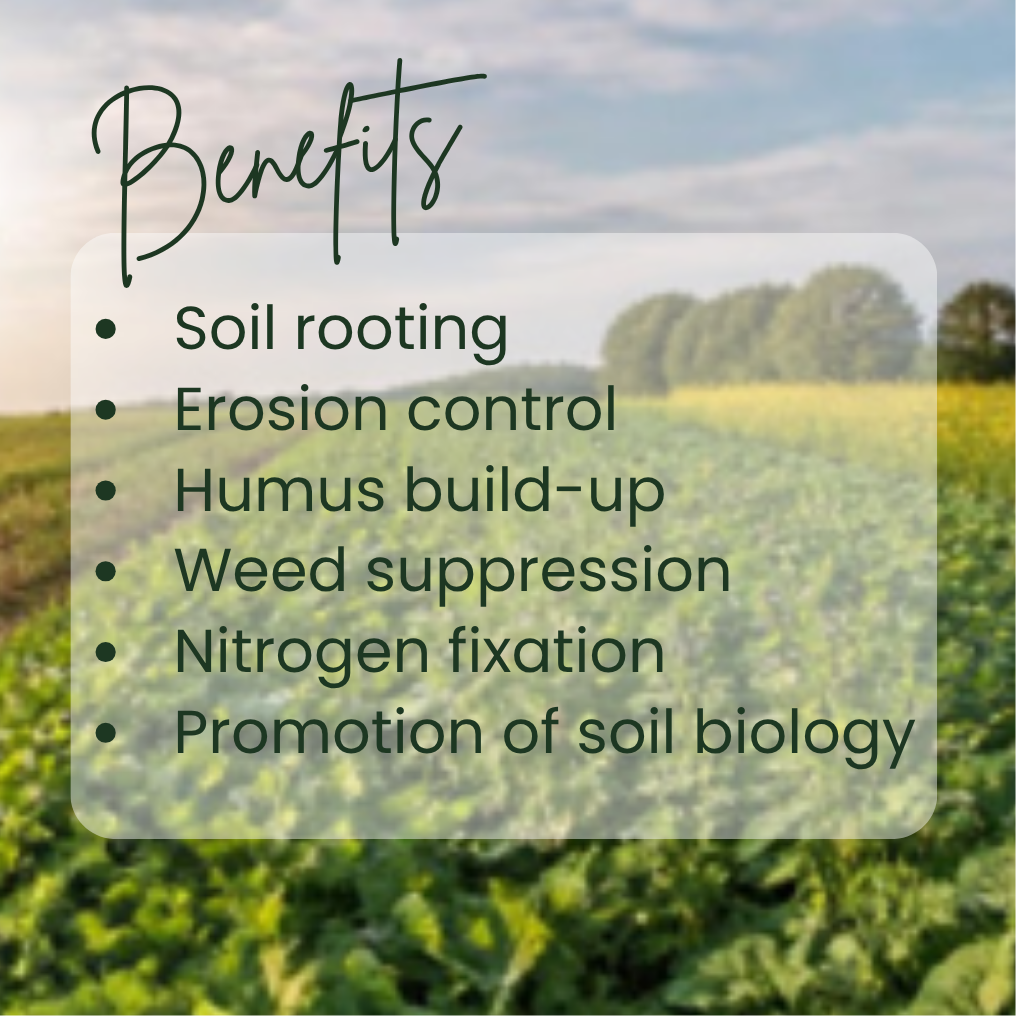
Cover crops take on several functions simultaneously within a modern crop rotation, and this is precisely where the challenge in choosing a mixture lies: a single species can rarely deliver all the desired effects equally well. The key functions include:
Soil structure and rooting: Deep-rooting species such as fodder radish, tillage radish or lucerne break up compaction layers and create coarse pores that benefit the following crop in spring.
Erosion control: Rapid, full ground cover protects against wind and water erosion – an aspect that carries particular weight on slopes and in erosion-prone locations.
Humus build-up: Over a period of several years, consistent use of cover crops makes a measurable contribution to maintaining and building up organic matter.
Weed suppression: Dense, competitive mixtures reduce weed pressure ahead of the following crop and can reduce the need for herbicides in spring.
Nitrogen fixation and retention: Legumes fix atmospheric nitrogen, while non-legume species such as mustard or fodder radish take up the mineral nitrogen remaining in the soil after harvest and prevent it from leaching over winter.
Supporting soil biology: Diverse rooting from different species encourages a broader range of soil microorganisms and mycorrhizal fungi.
A Mixture Strategy Rather Than a Single Species
For this reason, the trend in practice is increasingly towards species-rich mixtures with six, eight or more components. The idea behind this: the more varied the requirements and growth habits of the mixture partners, the more robustly the stand responds to changing weather conditions – after all, at the time of sowing in late summer, it is difficult to predict whether a wet or a dry autumn will follow.
When putting together a mixture, it is worth thinking in terms of functional groups:
| Functional group | Example species | Main benefit |
|---|---|---|
| Brassicas | Fodder radish, mustard, forage rape | Deep rooting, rapid ground cover |
| Legumes | Winter vetch, crimson clover, Persian clover | Nitrogen fixation |
| Broadleaf/other | Phacelia, buckwheat, niger (Guizotia) | Bee forage, weed suppression |
| Grasses/cereals | Spring oats, sudan grass | Structural stability, feed value |
What to Pay Particular Attention to When Choosing Mixtures in 2026
Crop rotation compatibility: The proportion of brassicas in the mixture should be kept low in tight oilseed rape rotations, to avoid unnecessarily increasing the risk of clubroot and nematode build-up. Where sugar beet is part of the rotation, nematode-resistant or nematode-tolerant fodder radish and mustard varieties should be used.
Variety purity and approval: Check whether the mixture used complies with current requirements in your region.
Frost sensitivity versus winter hardiness: Depending on the following crop and the planned spring cultivation date, a choice must be made between a frost-killed mixture (e.g. for early spring drilling) or a winter-hardy mixture (e.g. for later soil cultivation or grazing).
Seed rate and sowing depth: Mixtures with very different seed sizes require careful calibration of the drill, to ensure all components are placed evenly.
Our Conclusion
A well-thought-out cover crop mixture is an investment in your farm's soil fertility – with an impact reaching far beyond the current growing season. An “off-the-shelf universal mixture” rarely meets all requirements equally well. We are happy to advise and support you in tailoring the mixture to your crop rotation, soil type and objectives.