
Drought - Make your grassland look great again
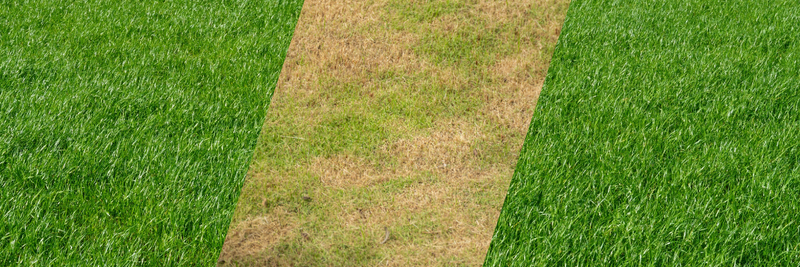
Not every brown field is irretrievably lost. We’ll show you ways to breathe new life into withered and drought-damaged grassland. The most appropriate course of action depends on the condition of the sward, the proportion of bare patches, the current soil moisture levels and the timing chosen.
AFTER THE DROUGHT COMES THE RAIN: RESPONDING APPROPRIATELY TO ENSURE LUSH PASTURES
The increasing frequency of extreme weather and climate events such as heatwaves, droughts, storms and prolonged rainfall poses major challenges for farms. This is currently evident very clearly. Following a predominantly dry winter of 2025/26 and a mild, dry spring of 2026 in Germany and other European countries, we are now in the midst of a summer characterised by heat and drought, with high temperatures and a lack of rainfall in many places.
The consequences are not only visible to farmers and felt in the feed trough, but are also increasingly being noticed outside the agricultural sector. Low water levels and parched soils are, in many places, accompanied by significantly damaged grassland stands. Where dense and high-yielding stands still stood in the spring, brown and yellow hues now often dominate. Particularly on light sites, shallow soils and areas with low water-holding capacity, grasses can suffer severe drought stress or even die off completely above ground.
Nevertheless, it is true that not every brown patch is lost for good. Various grassland grasses, including perennial ryegrass (Lolium perenne), timothy grass (Phleum pratense), meadow fescue (Festuca pratensis), tall fescue (Festuca arrundinacea) and red fescue (Festuca rubra), can survive dry spells and sprout again once soil moisture levels are sufficient. Therefore, following the first rainfall, one should initially observe whether and how well the existing sward is regenerating. This usually becomes apparent a few days after a rainfall event. Only then can a reliable assessment be made as to which measures are appropriate for repairing and maintaining the damaged sward.
During a drought: keep calm and, if necessary, tackle weeds in a targeted manner
As long as the dry spell persists and there is insufficient soil moisture, the options for actively improving the grassland are indeed limited. In specific cases, it may be worth considering weed control. In particular, the undesirable species in grassland – which are often highly drought-resistant, such as ragwort (Jacobaea vulgaris) or the typical sorrel species (Rumex ssp.) – can be easily identified amongst dead tufts of grass and controlled mechanically and/or chemically. Overseeding carries a high risk of failure under conditions of prolonged drought, as the seeds lack the water necessary for germination and early growth. This makes it all the more important to create the conditions for a resilient and productive grassland stand as early as spring. Through targeted soil cultivation – e.g. rolling, harrowing and/or raking – soil irregularities such as molehills can be levelled out in spring, effectively reducing weed and non-grass pressure. The aim is to achieve a sward that is as dense and productive as possible, well-prepared to withstand potential dry spells.
Even intensive mechanical interventions should be carefully reconsidered during periods of severe drought. This is because, whilst the drought persists, such measures serve little purpose and could cause further damage to the grassland and unnecessarily reduce the degree of ground cover. During a drought, even dead shoots and leaves help to protect the grassland soil from further drying out, overheating, degradation and crusting. The aim should be to avoid placing any additional strain on the already stressed stand. Residual vegetation should therefore be left on the land wherever possible. It is therefore often crucial not to act as quickly as possible, but to wait for the right moment. Only when sufficient moisture is present in the soil following rainfall (> 10 to 15 mm) and more favourable, cooler temperatures prevail will the conditions be right for measures to improve the grassland.
The right time for grassland improvement

Early spring drought or poor ground conditions following very wet winter months, combined with the increasing risk of summer droughts, can make traditional spring reseeding difficult. Late summer or early autumn often offers better conditions: cooler temperatures, sufficient rainfall and less competitive pressure from the existing sward create favourable conditions for the growth of new grasses.
Depending on the condition of the area, it may be advisable to start with a harrowing pass. This removes dead plant material, matted areas and unwanted plant species. At the same time, it slightly loosens the soil surface. Where there is heavy weed pressure, for example from common bluegrass (Poa trivialis) or annual bluegrass (Poa annua), the plants can be combed out of the sward using a sharply adjusted grassland harrow.
Before sowing, the existing sward can be cut back to a height of around 3–5 cm to ensure that the old sward shades the young plants as little as possible. It is also important to ensure good soil contact for the seed, which can be improved by rolling if necessary.
As soon as the new stand reaches a height of around 15 cm, an early coppice cut can help to suppress seed-borne weeds and encourage tillering in the desired new grass plants. The first subsequent cuts should also be carried out relatively early to provide the young plants with sufficient light and to promote tillering. High tillering is the basis for a high sward density later on.
Choosing the right reseeding method
The technique used depends primarily on the condition of the turf and the extent of the damage caused.
As a general guide: where the turf is still in good condition, with more than 50 per cent valuable grasses and fewer than 20 per cent gaps in the turf, overseeding may be sufficient. In cases of more severe damage, with more than 20 per cent of bare patches or more than 20 per cent of weeds and unwanted grasses, overseeding is usually more promising. Under suitable conditions, a germination rate of 60–70 per cent can be achieved.
To assess the extent of bare patches, the Göttingen counting and estimation frame can be used, for example. A rule of thumb here is always: one palm’s width of missing turf corresponds to around 15 per cent of bare patches. However, the actual seed rate required and the appropriate mixture always depend on the land’s use, the proportion of exposed soil and, consequently, the extent of the actual turf damage.
Slot sowing using a slot seeder, such as those manufactured by Vredo, is considered a particularly effective method. In this process, the seed is deposited directly into narrow slots, ensuring good soil contact. For stands that are less severely damaged, grassland harrows with an integrated reseeding unit are also suitable. They combine sward maintenance and sowing in a single pass.
In addition, various broadcast sowing methods are possible, such as pneumatic sowing technology, small-seed spreaders or pneumatic fertiliser spreaders. Drone technology is also being used increasingly. Crucial to success are sufficient soil contact for the seeds and adequate water during the germination phase.
Overseeding option – the three stages of MehrGras and ProGreen®
STAGE 1 – Standard measure: normal reseeding
For normal gaps in the sward, reseeding mixtures with a high proportion of perennial ryegrass (Lolium perenne) are recommended. Perennial ryegrass is characterised by rapid establishment and high competitiveness and therefore plays an important role in traditional grassland reseeding. The corresponding MehrGras reseeding mixtures are predominantly sown at a rate of 20 kg/ha and some are supplemented with white clover (Trifolium repens).
Some variants are also available as Mantelsaat®. In this process, the seed is coated with substances that strengthen the plants and are important for germination, in order to achieve better field emergence even under difficult conditions.
STAGE 2 – Seizing the opportunity: more severely damaged grassland
Where there are larger gaps in the sward, it is possible not only to repair the stand but also to specifically enhance its species composition; additional grass species such as meadow fescue, meadow grass, and red clover (Trifolium pratense) and white clover are suitable for this purpose. In late summer, slow-growing species also have a better chance of establishing themselves, as competition from the old sward is reduced. In the case of severely damaged areas, the transition from overseeding to reseeding can be gradual. In addition, the species composition is supplemented with pasture components suited to the site.
STAGE 3 – Visions: Making grassland sustainable with drought-tolerant species
On dry and summer-dry sites, reseeding can also be used to adapt the species composition in the long term to changing site and climatic conditions.
Species such as the more drought-tolerant grasses, for example, tall fescue (Festuca arundinacea) and cock’s-foot (Dactylis glomerata), are suitable for this purpose. In addition, forage legumes and herbs can be used. These include, amongst others, white clover, alfalfa (Medicago sativa), bird’s-foot trefoil (Lotus corniculatus), ribwort plantain (Plantago lanceolata) and forage chicory (Cichorium intybus).
Such mixtures allow the species composition to be specifically expanded to include biodiverse grasses, herbs and legumes, which can introduce additional desirable characteristics – such as improved palatability for grazing animals – into the stand in drier locations.
Conclusion
The summer drought of 2026 caused massive damage to grassland in many parts of Western Europe. However, whilst the drought persists, farms have few effective options available to them. The priority at present is to preserve existing grassland as much as possible and to avoid further stress. In this context, swift action is not automatically the best solution. A brown sward is not necessarily dead. It is therefore advisable to wait and see how the sward develops following sufficient rainfall.
However, with the onset of autumn rainfall, an important window of opportunity opens up for the revitalisation of damaged areas. Key factors here are the appropriate reseeding technique, a seed mixture suited to the site, and sufficient water for germination and early growth.
Particularly following dry years, reseeding thus offers not only the opportunity to fill any gaps that have formed. It can also be used specifically to make grassland stands more diverse in the long term and better adapted to dry site conditions.